ACh
BY BRANDCARE® • BRANDING SCIENCE℠
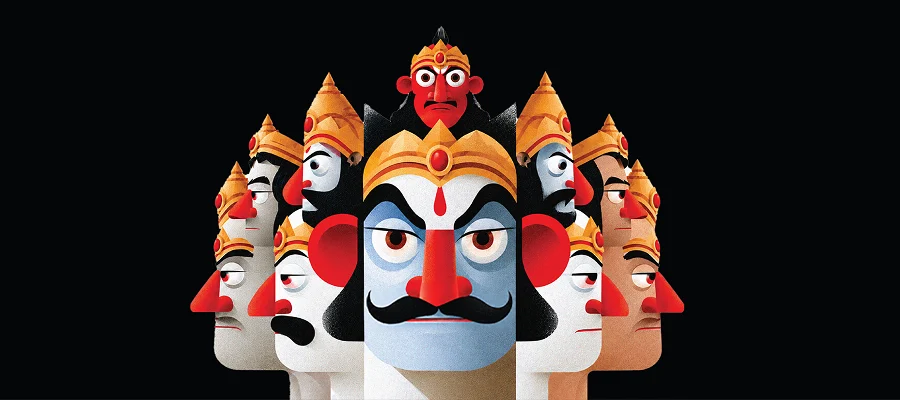
The Ravana Audit
It’s that time of the year when heads need to roll. Healthcare marketing has their own.
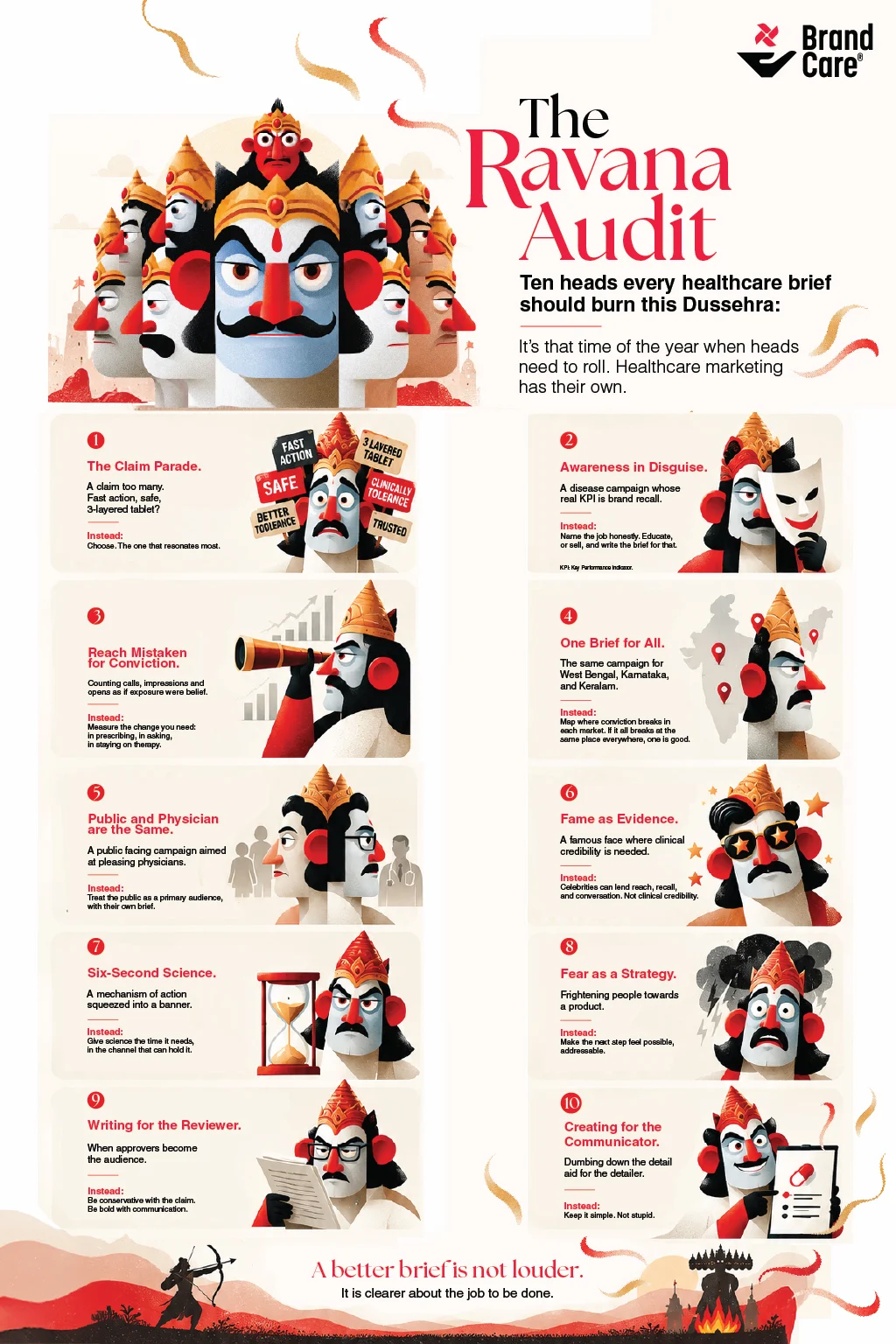
A claim too many. Are there too many claims you are making? Fast action, safe, 3 layered tablet?
Instead: Choose. The one that resonates most.
A disease campaign whose real KPI is brand recall.
Instead: Name the job honestly. Educate, or sell, and write the brief for that.
Counting calls, impressions and opens as if exposure were belief.
Instead: Measure the change you need: in prescribing, in asking, in staying on therapy.
The same campaign for West Bengal, Karnataka, and Kerala.
Instead: Map where conviction breaks in each market. If it all breaks at the same place everywhere, one is good.
A public facing campaign aimed at pleasing physicians.
Instead: Treat the public as a primary audience, with their own brief.
A famous face where clinical credibility is needed.
Instead: Celebrities can lend reach, recall, and conversation. Not clinical credibility.
A mechanism of action squeezed into a banner.
Instead: Give science the time it needs, in the channel that can hold it.
Frightening people towards a product.
Instead: Make the next step feel possible, addressable.
When approvers become the audience.
Instead: Be conservative with the claim. Be bold with communication.
Dumbing down the detail aid for the detailer.
Instead: Keep it simple. Not stupid.
Risk based is the model CDSCO is shifting to, easing checks on low-risk drugs to cut compliance burden. Faster, lighter approvals will speed some launches.
BrandCare: A lighter regulator means a shorter runway. Have the brand story ready before the approval lands.
86% of India's GLP-1 sales in August were injectables, as oral versions slipped. Patients chose the needle over the pill, inverting the convenience story the category was built to sell.
BrandCare: Convenience was the pitch; efficacy was the choice. Sell the outcome, not the format.
Upstream is where Indian pharma is heading. Mankind, Lupin and Torrent have built diagnostics businesses. Torrent's opened in 2026 with a national reference lab offering more than 3,500 tests. Cipla has gone deeper rather than wider, with two lung wellness centres, its own oscillometer and India's first sputum inflammatory lab.
BrandCare: Some are buying breadth; Cipla is buying depth. Either way, pharma has moved into the moment before the prescription.
Vietnamese is a customer of Long Chau, the pharmacy chain now adding vaccination, diagnostics, digital health and long-term care to more than 2,600 stores. The pharmacy is becoming a health system.
BrandCare: In Vietnam, the counter is where the consultation begins more than ever before.
Healthcare is trying long format content
In July 2024, JioCinema released Pill, an
eight-episode drama about a whistleblower exposing a drug
company. In December 2025, JioHotstar followed with Pharma, eight more episodes on the same theme.
Hours of story about
our industry, on two of India's largest streaming platforms.
Healthcare marketing has spent a decade on short
formats.
That earns recall. It may not earn conviction. Belief takes narrative, and
narrative takes time.
Main Kuch Bhi Kar Sakti Hoon demonstrated that when
media is culturally resonant, it can drive
long-term behavioral and social changes—like improving sanitation and
reproductive health.
Long-form has three parts: length, seriality (a story people
come back to), and patience (a story that trusts the audience to reach its own
conclusion). It asks three things of the brief that most healthcare briefs
avoid: a budget, success measured in time spent and return visits.
The long story about healthcare is being told. Behaviour will
change. Whether your brand will be the one to do that is a question you need to
ask yourself.
The norm it broke: Health brands ask to be trusted. This one, asked people to be suspicious, including the medicine they'd just bought from it. In a culture where patients accept a diagnosis and prescription in silence, Sawaal Uthao ("raise the question") made doubt the call to action. The answer was on the strip itself: every medicine sold through Tata 1mg carries a Track & Trace QR code. "Sells genuine medicines" moved from the second to the first reason people chose the platform.
When trust is the product, don't claim it. Make it something people can check, using a habit they already have.

The norm it broke: Oral care advertising shows the problem as something ugly: decay, bacteria, a dentist's warning. This campaign made the problem beautiful first. For five days, Mumbai's botanical garden displayed "India's newest flower species" in macro photographs. Every flower was a real, frayed toothbrush. Nearly one in two Indians keeps using a brush long past its life, and no one was told off. They found out for themselves.
People tune out warnings about their habits. They remember discovering the habit for themselves. Build the moment of discovery rather than delivering the lecture.
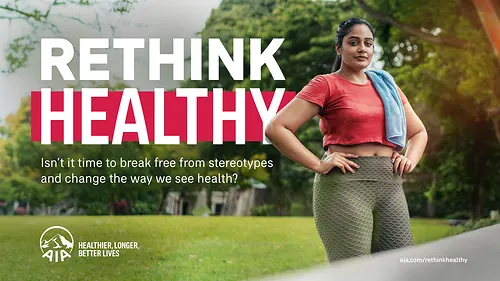
The norm it broke: Insurance advertising sells protection against illness, and health advertising sells an aspirational picture of fitness. This campaign said some of our ideas of "healthy" can do more harm than good. Its three films show a son under pressure to achieve, a mother whose pursuit of "healthy" quietly shapes her daughter's relationship with her body, and an older man who finds activity through dance rather than competition. The films don't resolve neatly or end on a message. The audience is left to draw its own conclusion.
A health brand can earn trust by questioning its own category definition of health. And sometimes the most persuasive move is to leave the conclusion to the audience.
Sleep score. Readiness score. Metabolic score. Step streak. Health now arrives graded out of 100.
The number was meant to open a conversation with your body. For many people, it has replaced that conversation. The patient walks into the consultation room carrying a score and a worry, and the physician must treat both.
For health brands, the temptation is to add another metric. The more valuable product may be the one that tells people which numbers to ignore.
Dussehra and Diwali arrive less than three weeks apart, and between them they carry two instructions. The first is to burn what no longer serves us. The second is to light a lamp and invite something in.
This issue began with the first. Let me end with the second.
The lamp I'd suggest we light this year is a simple one: build trust in the person on the other side of
our work, by being honest, transparent and sincere. If it's awareness it is awareness not promotion in
disguise. The creative has to leap from there. If it is education it is education not visibility for
physicians.
Shubh Navratri and a happy Deepavali to our readers in India, Singapore and across
Southeast Asia.