Key Takeaways From the 2026 Health Futures Playbook
India isn’t just living longer _ we’re living differently.
Health is no longer about treatment; it’s becoming a daily habit, a dashboard, a data trail, and increasingly, a lifestyle choice, led of course by the urban and semi-urban.
The metabolic moment is here.
With GLP-1s, CGMs, and preventive apps rising fast, metabolism is becoming the new battleground — where science, behaviour, adherence and aspiration collide.
A new health middle layer is emerging.
Platforms like Tata 1mg, GOQii and HealthifyMe are no longer “helpers” — they’re becoming the new health supermarkets, mediators, coaches, and fulfilment engines.
Lifestyle diseases are rewriting the map.
Hypertension, fatty liver, mental health, and cardiovascular burden aren’t side stories — they are India’s main health story now.
AI and new science will shape the next leap,
not hospitals alone. Diagnostics, decisions, and early detection are quietly shifting from human-dependent to AI-assisted – It’s impact on speed, scale and costs is yet to be known.
This shift isn’t limited to diagnostics — AI-enabled healthcare marketing tools are following the same trajectory, helping brands move from broad, one-size-fits-all messaging to precision communication shaped by real consumer and HCP behaviour data.
The same AI shift is transforming how pharma brands engage physicians at the field level — and how RepPlus uses AI for medical representatives is a direct response to this moment: equipping reps with real-time intelligence, personalised detailing content, and AI-powered call planning that makes every doctor interaction more relevant and more effective.
Women, Gen Z, and Tier-2
India are the new growth engines. Each segment comes with its own needs, gaps, and emotional truths which are rooted in India. Brands failing to be a part will miss the cultural moment.
Affordability remains the biggest friction –
and the biggest opportunity. Whoever cracks price accessibility for preventive care, metabolic drugs, and advanced diagnostics will own the next decade.
The future of health is hybrid:
data-driven, human-supported, and culturally grounded. India’s rituals, food, family systems, and digital adoption will shape how health actually shows up in our daily lives.
Health at an Inflection Point
At this inflection point, the signals are no longer subtle.
Patterns across data, behaviour, disease burden, and care delivery are beginning to converge.
2026 Healthcare Trends Index
The following themes emerge from the Health Futures Playbook 2026.
They are interconnected signals shaping healthcare — not isolated trends.
- • Consumer Health & Preventive Care
- • Obesity, Metabolic & Lifestyle Disorders
- • Women’s Health & Gender-Specific Care
- • Respiratory, Allergy & Chronic Conditions
- • Diagnostics, Screening & Early Detection
- • AI, Data & Technology in Healthcare
Together, these shifts explain why India is living longer — yet not necessarily healthier.
India’s Health Paradox –
Rising Lifespan, Shrinking Health-Span
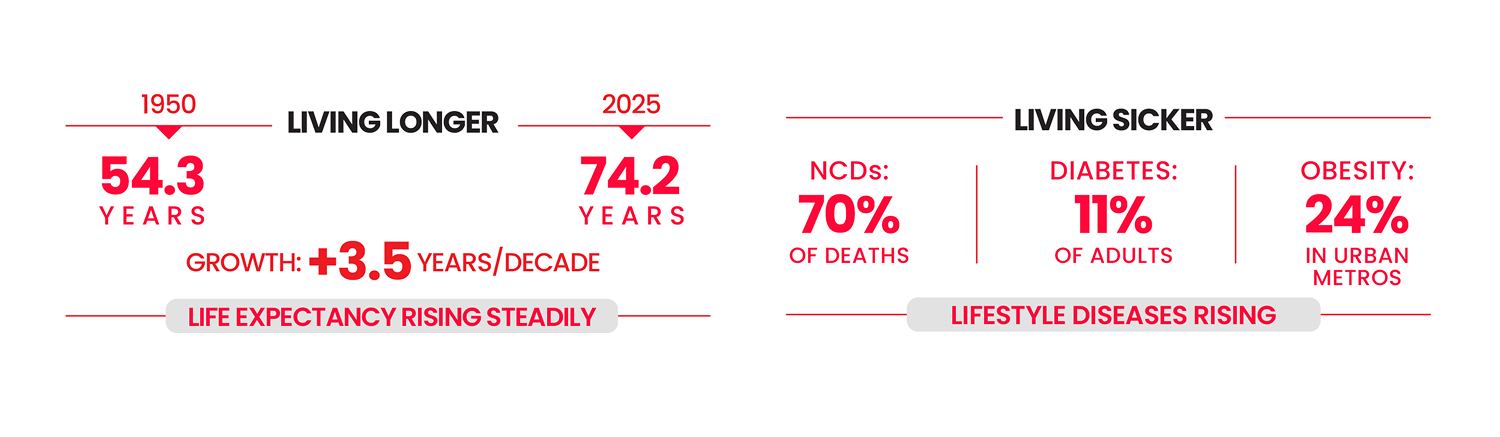
India’s health story is a bit of a contradiction, we’re living longer than ever, but not necessarily better. We’ve added years to our lives, yet lifestyle diseases are quietly stealing the quality from those years.
Diabetes, obesity, and NCDs are rising faster than we can adapt, turning longevity into a mixed blessing.
The real question now is: have we really gained anything by living longer or have we added more burdened years?
Source: ANI News / BCG Digital Health Adoption; WHO Global Health Observatory; World Economics Life Expectancy Dataset; WHO NCDs Fact Sheet; ICMR Disease Burden & Obesity Reports; BBC News; Nature
The Urban India Is Therefore Tracking Health Like Never Before
Metros 74% actively track health
Delhi-NCR: 78%
Mumbai: 76%
Bangalore: 75%
Chennai: 72%
Tier-2/3 Cities 36% actively track health
Pune: 42%
Bangalore: 38%
Ahmedabad: 35%
Kolkata: 30%
Tier-3/Non-Metro Regions: 12% actively track health
UP (excluding Lucknow, Noida, Kanpur): 10%
Bihar (excluding Patna): 8%
Rajasthan (excluding Jaipur, Jodhpur): 9%
Odisha (excluding Bhubaneswar, Cuttack): 7%
Source: Data.ai – India Health & Fitness App Trends 2025; BCG Digital Health Adoption Report; India State-Level Health Tracking Report 2025.
From smartwatches to CGMs to fitness apps, urban India has turned health-tracking into an everyday habit. With nearly 3 out of 4 metro residents actively monitoring steps, sleep, diet, or vitals. Health isn’t just reactive anymore — it’s a lifestyle cue, a daily dashboard, and in many ways, a new status symbol. Tier-2 cities are catching up fast, while rural India is still early in the journey, reflecting the clear digital and awareness divide in the country.
Fitness and Wearable App Downloads Growth
2025 88M
2023 58M
2022 40M
Source: Data.ai India Health and Fitness App Trends 2025
Wearable Device Adoption
CGM Devices:
12% adoption, +145% YoY growth
Smart Rings:
8% adoption, +220% YoY growth
Fitness Watches:
34% adoption, +89% YoY growth
Sources: IMARC Group – India Continuous Glucose Monitoring Devices Market; IDC Wearable Devices Tracker (Smart Rings); Future Market Insights – Fitness Watches & Wearables.
India’s Access – Adoption Divide
India’s adoption of advanced therapies or biosimilars isn’t one story – it’s three. The future of adoption will depend on who solves the right barrier in the right geography.

Sources: IQVIA – GLP-1 Market Penetration; The Ken – GLP-1 affordability, barriers & stigma analyses; Ministry of Health & Family Welfare – National Health Policy 2017; PM-JAY – Pradhan Mantri Jan Arogya Yojana; ABDM – Ayushman Bharat Digital Mission.
India’s Health Journey:
From Treatment to Transformation
2015 Go to Doctor When Sick
2020 Prevention Post-Pandemic Wake-up
2025 Track Before It Breaks
2026 New Science to Stay Healthy
India’s health mindset has moved from treatment—going to the doctor only when something goes wrong—to transformation, where tracking, prevention, and new science shape everyday choices.
What began as a wake-up call in 2020 is becoming a digital, proactive, and empowered health culture by 2026.
Health brands won’t just treat problems anymore—they’ll shape habits, guide choices, and become part of how India lives everyday.
Sources: Ipsos Global Mental Health & COVID-19 Surveys; ZS Future of Health Consumer Survey 2025; Financial Express + ZS Report – COVID-19 Pandemic Fitness Regime Analysis; IMARC Group India Digital Health Market Report 2025 – Behavioral Change Timeline (2015-2026)
India’s Emerging Health Consumer Archetypes
Metro Metabolic Manager
Urban, affluent, and tech-savvy, using advanced tools for metabolic health.
Tier-2 Access Advocate
Growing populations seeking affordable, accessible healthcare.
Gen-Z Digital Native
Online focussed, using apps and wearables for health guidance.
Women’s Health Specialist
Under-served women seeking credible support for PCOS, fertility, and menopause.
Rural Health Bridge
The largest group, facing trust, access, and affordability challenges, needing innovative 5 solutions.
These five distinct groups will be shaping the future of health demand in 2026.
Each archetype represents a large, addressable market with its own motivations, behaviours, and barriers.
Brandcare Foresight – Scenario, not forecast; directional only
Metro Metabolic Manager:
Urban, affluent, tech-forward consumers adopting GLP-1s, CGMs, and fitness tools to manage weight and metabolic health.
Tier-2 Access Advocate: A fast-growing population that wants good healthcare but struggles with affordability and access.
Gen Z Digital Native:
Highly engaged online, using apps, wearables, and social platforms for everyday health guidance—but hard to capture attention.
Women’s Health Specialist:
A large and under-served group seeking credible support for PCOS, fertility, and menopause, moving from tobacco to empowerment.
Rural Health Bridge:
The biggest segment by size, facing challenges of trust, access, and affordability – requiring last-mile innovation.
2026 Disease Outlook: The Big Shifts
India’s Health Burden Is No Longer Driven by Infections — It’s Driven by Lifestyle, Metabolism, and Mental Well-Being.
Cvd | >55M People
TB | Diverse Impact
Hypertension | >210M
Nafld | >95M
Fatty Liver | Emerging
Mental Health | >150M (1 in 7)
Respiratory | >35M
t2dm | ~90M (India)
Type 1 Diabetes | >3M
India’s disease burden is shifting fast, and this map shows the real picture at a glance.
The biggest bubble is hypertension — silent, widespread, and rising quietly across the country.
NAFLD and fatty liver emerge as the fastest-growing metabolic crises, fuelled by lifestyle shifts.
Mental health shows high growth but low mortality — affecting 1 in 7 Indians, shaping quality of life more than survival.
Meanwhile, CVD remains the deadliest, despite affecting fewer people than hypertension. Respiratory diseases stay stable but get sharply worse in polluted cities.
And in a rare positive signal, Type 1 diabetes shows a slow decline thanks to better awareness and care.
Source: Diabetes Association of India Epidemiology – CVD, Hypertension, NAFLD/Fatty Liver, Mental Health, Type 2 Diabetes, Respiratory, Type 1 Diabetes, and Tuberculosis Impact Studies; Health Burden Analysis – Lifestyle, Metabolism, and Mental Well-being Research
2026 Disease Outlook: The Big Shifts
Special Alert – Respiratory Crisis
Pollution Drives Admissions
Increase in respiratory cases at different AQI thresholds

AQI >150 = 18% spike in respiratory cases
AQI >300 = 35% spike
AQI >400 = 55% spike
Massive Health Burden ₹160,000 Cr Annual Cost (Healthcare + Lost Productivity)
Peak: Dec-Jan Pollution Season
Source: Diabetes Association of India Epidemiology; Respiratory Health Impact Studies – Air Quality Index Data; Winter Pollution Season Analysis; Healthcare Cost Burden Research India.
Forces Shaping Health in 2026
In 2026, Prevention Will Not Be a Trend — It’ll Be the Ticket to Gen Z’s Trust.
By 2026, Gen Z’s prevention-first mindset becomes the new normal. Brands that don’t speak this language will lose permission.
Boomers/Gen X: Reactive, Stoic
450M | 0 checks/year | “Wait for pain” Late diagnosis = chronic disease
Inference:
Doctor-centric messaging still works. Trust doctors first. Digital adoption = slow unless doctor endorses.
Millennials: Awareness Phase
380M | 1-2 checks/year | “Maybe I should track” Mixed tools = slow adoption
Inference:
Peak persuadably segment. App + HCP partnership messaging resonates. Early adopters = influencers for Gen Z.
Gen Z: Empowered Trackers
180M | Weekly data review | “Data = power” Wearables + apps + AI
Sources: Kantar Health & Wellness Expertise; Economic Times – ET Snapchat Gen Z Index; Redcliffe Labs + Skincare + iCICI Lombard Data; Spring Capital Research + Kantar Health Consumer Insights; ET Snapchat Gen Z Index Market Data; Spring Capital Research + Kantar Consumer Behavior Analysis.
Health in 2026 Won’t Just Change — It Will Accelerate.
These four mega-forces are the engines reshaping India’s health landscape by 2026. Each one is powerful alone — but together, they’re creating a once-in-a-generation shift
Improving accuracy in radiology with AI & Automation
Machines diagnosing faster and more accurately than humans.
AI & Automation are taking diagnostics from slow and human-dependent to fast, precise, and scalable — bringing expert-level care to more people.
Sources: The Lancet Digital Health; Nature Medicine; npj Digital Medicine; Nature Scientific Reports; BMJ – AI in diagnostics and digital health (2024–2025); FICCI-KPMG Healthcare Knowledge Paper 2025 on AI in Indian healthcare; Qure.ai peer-reviewed clinical validation studies.
GLP-1: 48% price drop New Science
Breakthrough therapies becoming accessible. Biosimilars changing the game.
New Science — from GLP-1s to biosimilars and new antimicrobials — is expanding what’s medically possible and making advanced therapies more accessible.
Sources: Reuters; Economic Times; Times of India; BBC News; India Today; CZ App – coverage of GLP-1s, biosimilars, and new antimicrobial science; IQVIA India Pharma Market Report 2025; investor communications from Dr. Reddy’s, Sun Pharma, and Biocon on GLP-1 and biosimilar strategy.
Access & Affordability
Policy enablers making premium care accessible to middle class and below.
Access & Affordability improvements through policy and pricing are opening premium care to the middle and lower-income segments.
Sources: Ministry of Health & Family Welfare – National Health Policy 2017 and India’s universal health coverage framework; CSEP healthcare equity research; Bain & Company healthcare access and affordability analyses; Express Healthcare coverage on policy-driven expansion of quality care.
650M+ ABDM IDs Digital Rails
Infrastructure enabling continuous health data flow and personalized care.
Digital Rails like ABDM, wearables, and health apps are creating continuous data flows, enabling personalized and preventive care at scale.
Sources: Ayushman Bharat Digital Mission (ABDM) official portal and NHA dashboards; NHA annual reports and PIB press releases on ABDM milestones; Medbound Times and eHealth (Elets) coverage of ABDM and wearables integration; Lancet eBioMedicine assessment of India’s digital health stack; India.gov.in National Digital Health Blueprint; MOHFW reports on e-Sanjeevani telemedicine.
Glp-1, Cgm &Amp; The New Stack
Signal: Metabolic Obesity, Earlier Onset

Obesity Exploding in Metros
24% of metro population obese (40M people) Metro obesity = 5x rural rates Moving AWAY from WHO targets
Source: BBC Coverage – Type 2 Diabetes Statistics; WHO Type 2 Diabetes Guidelines (2023); Kantar Health Awareness Survey (2024); Dr. Reddy’s/Sun Pharma/Biocon Q2-Q3 2025 Earnings; IQVIA India Pharma Market Report 2024-2025; Kantar Health Affordability Survey (2024); Dr. Reddy’s Investor Calls + Market Analysis; Biochem Pricing Projections (2026); Sun Pharma Manufacturing Scale-Up + Pricing Strategy; WHO/ICMR Data on Obesity Trends; Metro-level Epidemiology Studies; Rural vs Urban Health Disparity Research.
Glp-1, Cgm &Amp; The New Stack
Obesity Crisis for Real or a “Semaglutide Bubble”?
India: Adult Obesity (BMI ≥30): ~5-10% of adults – A rising epidemic
US: Adult obesity (BMI ≥30) is ~42%+ of adults – genuinely extreme.
However, in India: High prevalence of central / metabolic obesity at lower BMIs
Is There an Actual Obesity Problem in India?
Obesity in India as bad as the US? No.
However, is it a manufactured pharma narrative? Also no.
The signal is real; the profile is different -earlier onset metabolic risk, thinner-outside-fatter-inside, big urban skew.
New ICMR data talks about “metabolic obesity” (normal -BMI but high abdominal fat / metabolic risk as very common in Indian adults.
Source: ICMR-INDIAB National Study 2024-2025; National Family Health Survey (NFHS-5); CDC Obesity Prevalence Data; The Lancet Global Burden of Disease Study 2024; Elara Securities GLP-1 Market Report 2025; Reuters India Obesity Drug Market Analysis; The Lancet Report 2025 – India’s Obesity Crisis; NCBI/PMC Research on Metabolic Obesity in India.
Glp-1 Patient Access Journey

Metros lead GLP-1 adoption (8%) due to high awareness and affordability. Tier-2 cities are blocked by cost—biosimilar launches remove this bottleneck. Sources: IQVIA | Ipsos | Kantar | Grand View Research
Source: IQVIA India GLP-1 Market Penetration (metro, tier-2/3, rural adoption); Kantar and Ipsos health awareness and affordability surveys; Grand View Research and related obesity / GLP-1 market analyses for patient numbers and access patterns.
Glp-1, Cgm &Amp; The New Stack
Signal: Glp-1 as Lifestyle Drug?
Sequence Flip
Many consumers will quietly flip the sequence from: “Diet + exercise if I fail, I’ll take a drug” to “I’ll start GLP-1 then maybe I’ll sort out diet + exercise.”
This is human nature: if a powerful tool exists, people want it early, not as a last resort.
Off-Label, Vanity and “Event Use”
We’re likely to see: Normal-BMI or slightly overweight users taking GLP-1 purely for cosmetic weight loss (weddings, reunions, post-pregnancy “snap back”).
Diabetes Clinics 2.0
We’ll see more “Metabolic & Weight Clinics” in major cities offering:
- • GLP-1 / SGLT2 / other advanced meds
- • CGM-guided programs
- • Nutrition + physio + mental health in one package.
The Celeb Endorsement?
In a couple of years, GLP-1 may be treated like Botox:
- Nobody admits it
- Everybody knows
- Everybody does it
GLP-1s will quietly help change the story around obesity from: “You just don’t have willpower.” to “Your biology is stacked against you; we can now work with it.”
Brandcare Foresight – Scenario, not forecast; directional only
Glp-1, Cgm &Amp; The New Stack
After Glp-1, Cgm Is Also Ready to Go Mainstream: India’s New Metabolic Dashboard
CGM is expanding from clinical necessity (diabetes management) to lifestyle choice (performance optimization).
From ~ 0.3% penetration to 3% mainstream adoption = ₹5,000+ Cr market opportunity

Why 2026 Matters:
- • Price drops 60% affordability tipping point (₹10,000 ₹4,000/month)
- • Use cases expand clinical necessity (diabetes) to lifestyle optimization (wellness)
- • coverage expands government and corporate schemes drive accessibility
- • Market reaches ₹5,000+ Cr opportunity -> CGM becomes mainstream consumer product
Source: Abbott FreeStyle Libre India, IMARC Group India CGM Devices Market 2034, Future Market Insights Continuous Glucose Monitoring Systems Market, IDC Wearable Devices Tracker, IQVIA India Health Tech Market Report 2024-2025, McKinsey India Healthcare Affordability, National Health Authority Insurance Integration Roadmap, Grand View Research India CGM Market, Marketsandata India CGM Market. All data verified December 28, 2025.
Glp-1, Cgm &Amp; The New Stack
Will Cgms Shrink the Glucose Diagnostic Category?
If CGMs become democratised, the diagnostics market will migrate. Volume moves away from strips; value moves into insights.
If prices democratise (e.g., 70–90% cheaper or subscription bundles), three shifts are likely:
Rapid substitution of finger-prick testing for insulin users & motivated Type 2 users
These segments will move to CGM almost immediately:
- • Insulin-dependent diabetics
- • T2DM users with fluctuating control
- • Younger urban users with prevention-first mindsets
- • This alone cannibalises a high-frequency, high-margin strip business.
Hybrid behaviour emerges
Many patients will:
- • Use CGM intermittently (“1 month on, 2 months off”)
- • Use strip tests as backup for calibration or confirmation
- • This reduces strip volume, but the category does not disappear.
The market shifts from hardware -> data
As cost of sensors falls, value moves to: Insights
Brandcare Foresight – Scenario, not forecast; directional only
Cgm vs Glucose Diagnostics
2×2 Disruption Map: Vulnerability vs Value Capture

Strips become the “feature phone” of glucose monitoring
Still widely used, but not aspirational, not data-rich, and not the engine of growth.
CGMs become the “smartphone”
The center of the new glucose ecosystem.
Lab testing remains as validation
Fasting glucose, OGTT, HbA1c — these become periodic, not daily data substitutes.
Brandcare Foresight – Scenario, not forecast; directional only
Source: Abbott FreeStyle Libre India, Precedence Research CGM AI Analytics 2025, IQVIA India Pharma Integration, Marketsandmarkets BGM System Market 2025, Delve Insight BGM Systems Forecast 2024-2032, Coherent Market Insights Diabetes Diagnostics 2025-2032, Grand View Research India CGM Market 2033, Mordor Intelligence CGM Market Report 2025, Stellar MR POC Diagnostics 2025-2032, EY Insights CGM Market Trends 2025. All data verified December 28, 2025.
The Rise of the Health Mediators
In India’s evolving health ecosystem, a powerful new layer is emerging between maker and consumer — the health “mediators.”
Platforms such as GOQii, Tata 1mg, and HealthifyMe have moved from advisory or discovery-only roles into full-fledged care delivery and fulfilment.
Why This Matters:
Distribution advantage: Manufacturers or drug firms who partner with these aggregators get direct access to large, digitally-engaged consumer bases — faster and more scalable than traditional retail or hospital distribution.
New Engagement Models:
Health becomes a continuous relationship — not a one-time sale. Subscriptions, monitoring, repeat diagnostics, refills — giving lifetime value and recurring revenue.
Preventive-Care Positioning:
Aggregators can shift consumer behaviour upstream — from reactive treatment to proactive wellness — boosting uptake of diagnostics, preventive drugs, lifestyle therapies.
Speed-To-Market and Reach:
For new therapies (e.g. metabolic drugs, CGMs, biosimilars), this mediator layer can accelerate adoption outside metros, drive education, fulfillment, adherence tracking — all in one flow.
The Rise of the Health Mediator Layer (2026–2028)
4 Future Scenarios Explained Simply
(1) The Health Super-App Era
What it looks like: A single app becomes your doctor + coach + pharmacy + lab + delivery partner.
What mediators do:
- • Integrate CGM, wearables, GLP-1 monitoring
- • Offer diagnostics, teleconsults, medicine delivery
- • Provide coaching + AI-driven nudges
(2) The Preventive Subscription Model
What it looks like: Health becomes Netflix-style — continuous, personalized, recurring.
What mediators do:
- • Monthly metabolic monitoring packages
- • At-home diagnostics bundles
- • Preventive drug & refill subscriptions
- • AI alerts for early risk
(3) The Mediator as Marketplace Powerhouse
What it looks like: Platforms like Tata 1mg become the “Amazon of health”, controlling discovery, comparison, reviews, and fulfillment.
What mediators do:
- • Rank products & therapies
- • Create “preferred partner” ecosystems
- • Offer health influencer integrations
- • Own the consumer search journey
(4) The Virtual Clinic Network
What it looks like: Digital-first platforms build hybrid care: app + doorstep services + offline micro-clinics.
What mediators do:
- • Offer “CGM + consult + lifestyle plan” packages
- • Create GLP-1 starter clinics with onboarding
- • Build Cardio-Diabetes hubs inside Tier-2/3 cities
- • Link wearables to rapid intervention teams
Drug+Device+Data+Human Coach
The “Metabolic Stack”: GLP-1 + CGM + apps is a new premium health stack emerging:
- • GLP-1 (or similar) as the pharma pillar,
- • CGM and wearables as the data layer,
- • Coaching / AI apps as the interpretation + motivation layer.
Platforms like GOQii, HealthifyMe, Tata 1mg etc. are perfectly placed to package this as: “Metabolic Reset Programs” – drug + device + data + human coach.
Special Focus: Infections &Amp; Amr
A Decade of Silence. One Year of Breakthroughs. India Leads the Comeback
2015-2024 (10 Years)
Only 4 New Antibiotics
(Global)
10 Years Without New Class
1.3 M Drug-Resistant Deaths/Yr Globally (Who Data)
2025 (1 Year Breakthrough)
2 Major Launches in India
Zaynich (Wockhardt) Zidebactam + Cefepime
Nafithromycin (Indian Govt.) = Resistant Respiratory
2026 Watch: 5+ new antibiotics in pipeline; stewardship messaging critical
The past decade has been bleak for global antibiotics — only four new drugs worldwide and no new class in ten years, even as drug-resistant infections kill 1.3 million people annually (WHO).
And then comes 2025, a rare bright spot: India launches two major antibiotics in a single year — Wockhardt’s Zaynich (Zidebactam + Cefepime) and Nafithromycin for resistant respiratory infections.
It signals a long-awaited shift: India stepping up innovation just when the world needs it most.
Source: WHO Global Antibiotic Resistance Surveillance Report 2025, WHO Fact Sheet – AMR 2023, Wockhardt Press Releases (Q4 FY25, NDA Submission Oct 2025), FDA Novel Drug Approvals 2025, CDSCO Approval (Express Pharma Jan 2025), PubMed – Novel Macrolide Antibiotic Nafithromycin (Aug 2025), MedCityNews GSK Blujepa Approval (Mar 2025), Labiotech.eu Antibiotic Development Landscape 2025, ScanX Trade – Wockhardt FDA Milestone (Dec 2025), IHME India AMR Burden Analysis, Down to Earth WAAW 2025, BSAC & UN News AMR Crisis Alert (Oct 2025). All data verified December 28, 2025.
Special Focus: Infections &Amp; Amr
Responsibility Will Be the Buzz Word in Infections
The new breakthroughs in antibiotics may be too soon to rejoice. Looking ahead to 2026, with five or more antibiotics in the pipeline, the real challenge won’t just be discovery — it will be responsible stewardship, so these new weapons don’t lose their power too soon.
Resistance Rates by Bacteria and Region

Source: ICMR Antimicrobial Resistance Surveillance Network (AMRSN) Annual Report 2024, Ministry of Health National Action Plan on Antimicrobial Resistance (NAP-AMR 2.0) November 2025, National Centre for Disease Control (NCDC) AMR Containment Programme, State Health Departments (Delhi, Maharashtra, Tamil Nadu, Karnataka, West Bengal), WHO Strategic and Technical Advisory Group on Antimicrobial Resistance (STAG-AMR), ICMR National Antibiotic Stewardship Program. All data verified December 28, 2025 IST
The New Shape of Wellness in 2026
As illness trends accelerate, India’s response is showing up in everyday choices: what we eat, how we sleep, and how we use our homes.
Across every major wellness dataset, cultural trend, consumer signal, and product launch pipeline, food and sleep are emerging as the two dominant pillars shaping 2026. Every health trend eventually loops back to either:
- • What we eat
- • How we rest and recover
Food Is Becoming Medicine Again
But this time backed by science, sensors, and social influence.
Protein-first diets, millets, gut health, and functional foods are exploding. Food is no longer just nutrition — it’s prevention, performance, and longevity.
Sleep Is the New Stress Indicator
Sleep is no longer “nice to have” — it’s become a health KPI. Sleep scores from wearables dictate behavior. Corporate India is talking burnout, brain fog, and recovery. Sleep-tech (white noise, Oura rings, mindfulness apps) is booming. Sleep is increasingly seen as productivity, emotional resilience, and aging control.
The Carb Crisis Is Responding With the Protein Correction

Source: ICMR Nationwide Dietary Survey 2025, India Today Reports (September-December 2025), Mintel India Functional Foods Market Report 2025, Ministry of Agriculture & Farmers Welfare (Government of India), TechSci Research India Healthy Snacks Market 2025, Grand View Research India Protein Supplements Outlook, Market Research Future India Protein Ingredients 2025, NABARD Millet Engagement Report, Coherent Market Insights Functional Food Market 2025-2032. All data verified December 28, 2025 IST.
The Wake up Call for Poor Sleep

Source: Philips India Sleep Health Survey 2025, LocalCircles Sleep Disruption Survey 2025 (41,000 respondents), ResMed Global Sleep Survey 2025 (30,000+ respondents), Wakefit Great Indian Sleep Scorecard 2024, Statista Meditation Apps Market Forecast India, Future Market Insights Mindfulness Application Report, Technavio Sleep Tech Market Analysis 2025-2029, India Today Health Coverage 2024-2025, Economic Times Sleep Analysis Reports 2025, Ministry of Health & Family Welfare. All data verified December 28, 2025, 10:55 PM IST.
We Asked AI What AI Can Do — and This Is the Future Home It Imagined.
A home where healthcare doesn’t live in hospitals but flows through every room. AI sees the home becoming India’s next health hub. And honestly, it’s not far from reality. With connected devices rising, telemedicine normalising, and families juggling aging parents and busy lives, this vision feels less like science fiction and more like our near-future blueprint.
Home as a Health Hub: The Connected Healthcare Home

Health will move from hospitals to homes.
Care will shift from reactive to continuous.
Your home will become your first clinic — and your first coach.
Source: Grand View Research India Digital Health Market 2033, IMARC India Home Healthcare Equipment & IoT Connectivity Markets, Coherent Market Insights Connected Healthcare 2025-2032, Archive Market Research India Smart Wearable Industry, Future Market Insights Eldercare Robotics 2035, InsightAce AI in Aging & Elderly Care 2034, SecondMedic India Telemedicine Analysis 2025, NITI Aayog Senior Care Reforms 2024, Economic Times Digital Health Infrastructure 2025, Ministry of Statistics Youth Digital Engagement 2025, MarketsandMarkets IoT Medical Devices 2030, OC Academy Wearables in Chronic Disease Management, PMC NIH Wearable Devices & AI Remote Monitoring. All links verified December 28, 2025, 11:15 PM IST.
From More Years, to Better Years.
By 2026, India’s health story is no longer just about hospitals, molecules, or markets. It is about a country quietly renegotiating its relationship with its own body. We’re living longer, yes – but we are also learning, sometimes painfully, that more years mean little if they are not lighter, clearer, and more alive.
The signals in this Playbook – from GLP-1s and CGMs to sleep dashboards, protein plates, mediator platforms and home health hubs – all point to the same truth: health is moving closer. Closer to the wrist, the kitchen, the bedroom, the family WhatsApp group. Closer to everyday decisions instead of rare emergencies.
For brands and institutions, this is both an invitation and a responsibility. The invitation is to design tools, therapies and stories that fit into real Indian lives – affordable, respectful, culturally fluent. The responsibility is to use science and AI not just to sell more, but to spare people avoidable suffering: by catching risk earlier, treating smarter, and communicating more honestly.
If the last decade was about adding years to life, the next one has to be about adding life to those years. The choices we make now – as creators, clinicians, companies and citizens – will decide whether India’s health future is simply longer, or genuinely better.
The future of health in India won’t be built in ICUs – it will be built in kitchens, bedrooms, browsers and everyday choices.
Disclaimer: The Health Futures Report 2026 is curated by experts at Brandcare from secondary sources including but not limited to news reports, market research studies, digital platforms, medical institutions, government bodies, among others. The basis of information mentioned in the report is based on secondary sources and are as accurate as reported by third-arties. Brandcare’s interpretation, opinion and forecast in labeled accordingly.
If you wish to receive more details regarding the sources, please get in touch with us.
FAQ
What are the biggest health trends shaping India in 2026?
India’s health story in 2026 is defined by six converging forces: the rise of metabolic and lifestyle diseases, GLP-1 and CGM adoption, women’s and Gen Z health needs, AI-assisted diagnostics, digital health infrastructure through ABDM, and the emergence of health mediator platforms like Tata 1mg, and GOQii. Together, they signal a fundamental shift from treatment to transformation.
How is AI changing healthcare and health communication in India?
AI is quietly moving diagnostics from human-dependent to fast and scalable improving accuracy in radiology, enabling early detection, and reducing costs. Beyond clinical use, AI-enabled healthcare marketing tools help brands personalise communication, identify the right engagement windows, and reach both HCPs and consumers with greater precision than traditional approaches ever allowed.
Which consumer segments should healthcare brands prioritise in 2026?
Three segments are driving growth: the Metro Metabolic Manager adopting GLP-1s and CGMs; Gen Z Digital Natives using apps and wearables for weekly health tracking; and the Tier-2 Access Advocate, a fast-growing population ready for good healthcare, blocked mostly by affordability. Brands that speak to all three differently will lead the decade.
Why is the shift from treatment to prevention important for healthcare brands right now?
Because the way Indians think about health has flipped. The old habit was to visit a clinic only when you fell sick. Today, people focus on tracking their vitals, avoiding illnesses, and managing their daily wellness. Healthcare brands that only talk about treating sickness will completely miss the mark with Gen Z and Millennials. These proactive consumers are already the most active and digitally connected audience out there.
What does the rise of health mediator platforms mean for pharma and healthcare brands?
Platforms like Tata 1mg, GOQii, and HealthifyMe have moved beyond discovery, they now own fulfilment, coaching, diagnostics, and adherence. For brands, this mediator layer offers faster reach, continuous consumer relationships, and access to Tier-2 markets at scale. Ignoring them means ceding the consumer health journey to platforms that are already building it without you.